- Key Sections of a Clinical Research Associate Resume
- Professional Summary
- Core Skills and Keywords
- Work Experience (With Metrics)
- Certifications and Education
- CRA Resume Example
- Professional Summary
- Core Skills
- Work Experience
- Certifications & Education
- Skills and Keywords to Include
- Writing Tips for Entry-Level and Senior CRAs
- Making Your Resume ATS-friendly
- Build a Resume That Stands Out
- Frequently Asked Questions
- How do I write a clinical research associate resume with no experience?
- What certifications should I list on a CRA resume?
- How long should a clinical research associate resume be?
A clinical research associate resume has to prove two things at once: that you understand GCP and trial protocols, and that you can manage the paperwork, monitoring visits, and deadlines that keep a study compliant.
A polished, ATS-friendly clinical research associate resume can convey both clearly. In this article, we have shared the key sections to include in your CRA resume along with an example to help you stand out.
Key Sections of a Clinical Research Associate Resume
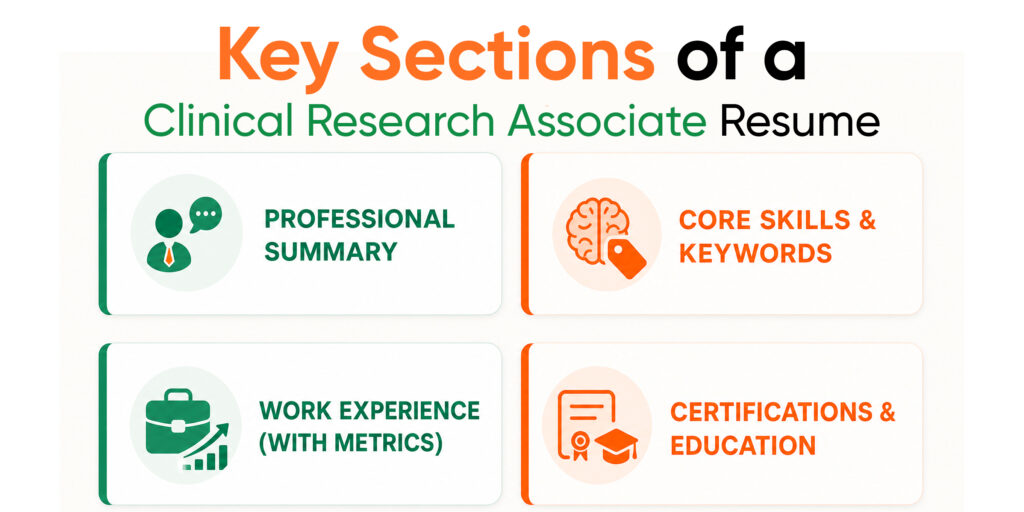
Whether you’re building from a blank page or adapting a CRA resume template, four sections carry the most weight. Get these right, and the rest of the resume falls into place. These are the must-haves:
Professional Summary
Three to four lines at the top, stating your years of experience, therapeutic area focus, and one or two standout results. This is where a hiring manager decides whether to keep reading, so skip the generic opening line and lead with specifics.
Core Skills and Keywords
A short list of hard skills pulled from the job posting. This can include:
- Site monitoring
- Informed consent review
- CTMS software
- Regulatory documentation
Applicant tracking systems scan this section closely, so keywords for a clinical research resume matter as much here as anywhere else on the page.
Work Experience (With Metrics)
Reverse-chronological job history, each role backed by two to four bullet points. Numbers matter more here than in almost any other section: sites monitored, studies supported, patient enrollment figures, audit findings resolved.
Certifications and Education
Degree, plus certifications like CCRP, CCRA, or ACRP-CP if you have them. GCP training belongs here too, even if it was part of a course rather than a standalone certification.
CRA Resume Example
Here’s a sample built around these four sections. The details are fictional, but the structure mirrors what a hiring manager in this field expects to see.
Professional Summary
Clinical research associate with 3 years of experience monitoring Phase II and III oncology trials across 12 sites. Skilled in source data verification, regulatory binder maintenance, and CTMS reporting. Consistently meets monitoring visit deadlines with zero major audit findings.
Core Skills
Site monitoring & SDV | Informed consent review | ICH-GCP compliance | CTMS (Veeva, Medidata Rave) | Regulatory documentation | Risk-based monitoring | Patient safety reporting | Cross-functional communication
Work Experience
- Monitor 8 active oncology trial sites, conducting routine and for-cause visits on schedule 100% of the time.
- Review source documents and case report forms for accuracy, identifying and resolving discrepancies before database lock.
- Support enrollment of 140+ patients across assigned sites by coordinating closely with site coordinators on protocol adherence.
- Maintain regulatory binders and essential documents, passing two sponsor audits with zero major findings.
- Assisted CRAs with trial master file setup and maintenance across 5 concurrent studies.
- Tracked site payments, IRB submissions, and study timelines using Veeva Vault.
- Coordinated shipment and inventory of investigational product across 15 sites.
Certifications & Education
- B.S. in Biology — University of Illinois at Chicago, 2020
- Certified Clinical Research Professional (CCRP) — SOCRA, 2022
- ICH-GCP Certification — 2020
Skills and Keywords to Include
Beyond the core skills list, weave clinical research associate resume skills into your bullet points wherever you can. A phrase like “monitored 6 sites for GCP compliance” carries more weight than “monitoring” sitting alone in a list, since it shows the skill applied to a real result. Common ones worth working in:
- Source data verification (SDV)
- Protocol deviation identification and reporting
- Risk-based monitoring (RBM)
- eTMF and CTMS platforms (Veeva, Medidata, Oracle Clinical)
- IRB/EC submissions
- Investigational product accountability
- Adverse event and safety reporting
Pull the exact terms from the job posting when you can. If a listing says “informed consent review” and your resume says “consent form auditing,” an ATS may not connect the two.
Soft skills are often what separates two similarly qualified candidates once a hiring manager reads the resume. Here are some skills worth including:
- Attention to detail, especially when reviewing source documents against case report forms
- Communication with site staff, investigators, and sponsors across a study
- Time management across overlapping monitoring visits and deadlines
- Problem-solving when a protocol deviation or site issue comes up mid-study
- Adaptability to protocol amendments and shifting study timelines
- Organizational skills for managing regulatory documentation and trial master files
Don’t just list these on their own line. A bullet like “resolved a site-level protocol deviation within 48 hours, coordinating between the investigator and sponsor” shows problem-solving and communication at once, without ever using either word.
Writing Tips for Entry-Level and Senior CRAs
An entry-level clinical research associate resume and a senior clinical research associate resume should read differently, even if they cover similar skills.
If you’re building a clinical research associate resume with no experience, lean on your education, GCP certification, and any adjacent roles. Examples include clinical trial associate, research coordinator, lab assistant, or even a clinical internship.
Frame coursework and hands-on training as directly relevant, and don’t skip a skills section just because your work history section is short.
For a senior clinical research associate resume, shift the emphasis toward scope and leadership. This means mentioning the number of sites or studies managed, mentoring junior CRAs, involvement in protocol design, or therapeutic areas you specialize in.
Quick tip: Hiring managers reading a senior-level resume are checking for independence and judgment, not just task completion.
Making Your Resume ATS-friendly
A few formatting habits can make your CRA resume ATS-friendly and readable by both software and people:
- Use standard section headers (Experience, Education, Skills) rather than creative labels.
- Avoid tables, text boxes, and columns, since some parsers misread them.
- Save and submit as a .docx or PDF, whichever the application specifies.
- Match your job titles to industry-standard terms where accurate, since “Clinical Research Associate” will match more searches than an internal title unique to one company.
- Spell out acronyms once (Institutional Review Board, IRB) so the resume matches both the abbreviated and full-text search terms recruiters use.
A clean, well-organized resume built around these four sections will hold up whether it’s read by software first or a hiring manager first, and that’s the real test for any CV for clinical research roles in 2026.
Build a Resume That Stands Out
A strong clinical research associate resume comes down to specifics: real numbers, the right keywords, and a scannable structure. Get those three right, and you’re ahead of most applicants in the pile.
Ready to put it together? Build your CRA resume with Jump Resume Builder and get an ATS-friendly resume in minutes.
Frequently Asked Questions
How do I write a clinical research associate resume with no experience?
Lead with your GCP certification, degree, and any adjacent roles like clinical trial associate, research coordinator, or lab assistant. Use your skills section to show you understand monitoring, documentation, and compliance even if your job titles don’t say “CRA” yet.
What certifications should I list on a CRA resume?
CCRP (SOCRA), CCRA (ACRP), or ACRP-CP if you hold them, along with your ICH-GCP training. If you don’t have a certification yet, list GCP training on its own since most employers expect it regardless of certification status.
How long should a clinical research associate resume be?
One page for anyone with under 8 to 10 years of experience. Senior CRAs with a longer track record across multiple studies can extend to two pages, but only if every line adds new information.
- Key Sections of a Clinical Research Associate Resume
- Professional Summary
- Core Skills and Keywords
- Work Experience (With Metrics)
- Certifications and Education
- CRA Resume Example
- Professional Summary
- Core Skills
- Work Experience
- Certifications & Education
- Skills and Keywords to Include
- Writing Tips for Entry-Level and Senior CRAs
- Making Your Resume ATS-friendly
- Build a Resume That Stands Out
- Frequently Asked Questions
- How do I write a clinical research associate resume with no experience?
- What certifications should I list on a CRA resume?
- How long should a clinical research associate resume be?